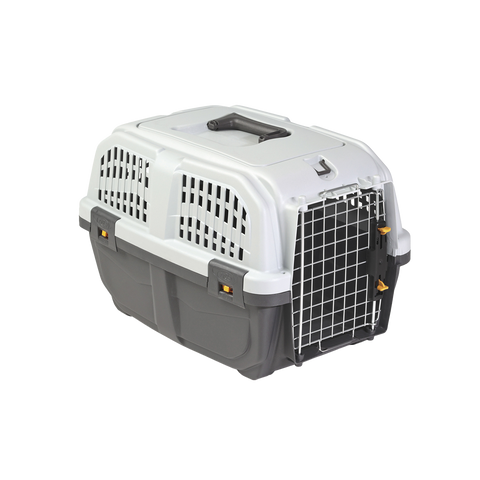
Short answer: for small dogs and cats up to around 7–8 kg, the choice is usually between a soft handheld carrier, backpack or sling – convenient for short outings and public transport – and a hard plastic carrier, better suited to the car, the vet, and less settled pets. The main things to weigh up are the maximum permitted weight, the ventilation, and how comfortable it is for you to carry.
Soft carrier, backpack, sling or hard crate – what's the difference
Soft "tote"-style carriers, backpacks and slings distribute your pet's weight differently against your body, and usually have mesh ventilation panels and a removable cushion. Hard plastic carriers and crates offer a sturdier build, closed walls with ventilation openings, and a locking door – better suited to when the animal needs to be as protected and still as possible, for example in the car or during an examination. Between the two extremes there's also the semi-rigid "cabin"-style carrier, where a fabric outer is reinforced with a firmer inner frame.
Weight and size of your pet
Most soft formats are designed for dogs and cats up to 7–8 kg. The Uniq Pets FurTote FurryHeart and Uniq Pets FurPack PetPacker are for up to 7 kg, while the UniQ Sling Bag is intended for the very smallest pets. For heavier cats and small dogs up to 8 kg, see the Uniq Pets FurCabin PetComfort. If you prefer a rigid build, the MPS P-Bag is a light plastic carrier for up to 5 kg, while the MPS Pratiko 1 Plastic offers more interior space. If you're unsure of the exact size, measure your pet standing up – from the floor to the top of the head or pricked ears – and by length from the nose to the base of the tail, before choosing a model. Inside, the animal should be able to stand, turn round and lie down comfortably.
Ventilation and comfort
Good ventilation matters for both soft and hard carriers. The FurTote and FurPack models rely on mesh panels on several sides, and the sling on an open top, while the MPS hard carriers have ventilation openings in the walls and a clear or grille door. For longer carrying, a backpack or sling distributes the weight more evenly than a carrier held only by hand, and the removable cushion in the FurTote and FurPack makes washing easier. If your pet is bothered by a lot of visual stimulation, a closed carrier with smaller windows usually settles it more than a clear door with a view in every direction.
Also check how easy it is to fasten and open with one hand, the length and padding of the strap, and whether the inner lead (where there is one) clips onto a harness rather than directly onto a collar – that way your pet can't slip out unexpectedly while the carrier is open.
Public transport
When travelling by bus, metro or taxi, a closed carrier with good ventilation is usually more convenient both for you and for people around you – it limits your pet's contact with strangers and reduces the risk of it getting frightened and bolting. A sling is practical for very small, calm animals, but it doesn't offer the same protection as a closed carrier if your pet is suddenly startled by noise or a crowd. If you regularly travel on public transport, check the carrier's rules in advance for the size and manner of transporting animals.
Visiting the vet
For the vet's surgery, a hard carrier has the advantage – it can stay closed and stable in the waiting room, and the top of the MPS Pratiko models comes off easily if an examination needs to be done right inside it, without taking the animal out entirely. A soft carrier or backpack is enough for calmer cats and dogs used to being carried, especially for short check-ups or vaccinations.
When a hard carrier is the better choice
Choose a hard carrier when your pet is more unsettled, you're travelling further by car, or you need a model that meets air transport requirements – flying calls for specifically marked IATA models, not a soft carrier. The soft format remains a convenient choice for everyday walks, outdoor outings and public transport with a calmer pet. When choosing between the two, also think about how practical they are to clean – hard plastic surfaces wipe clean more easily after an accident, while the fabric parts of soft carriers are usually machine-washable.
Suitable products
Browse the full range in the Carriers collection, including the Uniq Pets models.
Read more: How to travel with a dog or cat and Uniq Pets: treats and accessories.
Frequently asked questions
Can I carry a cat in a sling on a long walk?
For short outings, most cats manage well once they've got used to it gradually. For a longer trip, a closed carrier with more space is more comfortable, since the cat can change position.
Is a backpack more comfortable than a handheld carrier?
For longer carrying, usually yes, since it spreads the weight across both shoulders. The choice also depends on personal comfort, and on how settled your pet is while it's behind you rather than in front of your eyes.
Is a hard carrier safer in a car?
Usually yes, especially when secured to the seat with the car's seatbelt – it's more stable during braking and turns than a soft carrier held on your lap or placed unsecured on the seat.
Are a sling, backpack or soft carrier fine for a flight?
Usually not – airlines require specific, marked carrier or crate models, not just any soft carrier or backpack. Check the airline's requirements directly before you travel.